AI-Powered Innovation Portal
A web platform that uses AI and natural language processing to take the repetitive work out of data research, freeing researchers to focus on higher-value analysis.
| Client | Laterite |
|---|---|
| UN SDGs | 01 No Poverty 02 Zero Hunger 10 Reduced Inequalities |
| Impact | Ethiopia Kenya Netherlands Rwanda Sierra Leone Tanzania |
| Technologies | AI, NodeJS, PHP, Python, MySQL |

01 Introduction
Laterite.ai is a web platform that helps data research professionals work through their data analysis more efficiently. Laterite - a respected social impact research organisation operating in the Netherlands and across Africa - partnered with us to build an accessible web platform that uses Natural Language Processing (NLP) to speed up research and analytics.
Like many in their field, Laterite faced a real challenge handling large volumes of information that needed careful verification, correction, and logging. This processing ate up time that could otherwise go into more valuable research. They wanted a web app that could streamline data cleaning and give researchers tools to work more efficiently. Machine learning - and Large Language Models in particular - were central to the solution, making it possible to extract meaning, analyse sentiment, and draw useful insights from text.
02 The Project
The main goal was to take the repetitive parts of research off researchers' plates, giving them tools that boost efficiency and free up space for original thinking. By streamlining the process, the platform aimed to help researchers maximise the social impact of their work.
The platform lets researchers register, choose a subscription tier, pay online, and use allocated tokens to access a range of research apps. Tokens reset each month and can be topped up by buying more online. This token system kept the platform aligned with OpenAI's pricing model and helped manage the costs of data processing.
We kept the design simple, aiming for something familiar and easy to use. The colour scheme followed Laterite's corporate branding, combined with a mix of AI-generated images and photography from Africa. We optimised page loading times and kept transitions and animations to a minimum, favouring a flat, clean interface.
We took a waterfall approach, prioritising features for the Alpha release using the MoSCoW method. As we went, we added more apps to stress-test the code's robustness and surface areas for improvement as the platform grew.
On the technical side, we used PHP on the frontend for speed and reliability, with NodeJS as middleware to handle longer requests, and Python to interface with the AI technologies. AI processing time was a recurring challenge: we introduced NodeJS to avoid timeouts on data transactions that ran longer than a web server would normally hold a connection open for. This let users either wait or come back later while their requests processed. To handle busy periods, we built in request queuing - prioritising quick text-based requests, while file uploads were processed according to available server resources.
The suite of automated tools draws on advanced large language models, including OpenAI's GPT-3 and NVIDIA's NeMo LLMs. These support a wide range of tasks - coding assistance, error correction, survey creation, data classification, topic modelling, and more. Stripe integration handled secure payments for subscriptions and tokens, and security measures included server-side storage of secure keys and rate limiting to prevent abuse and spamming.
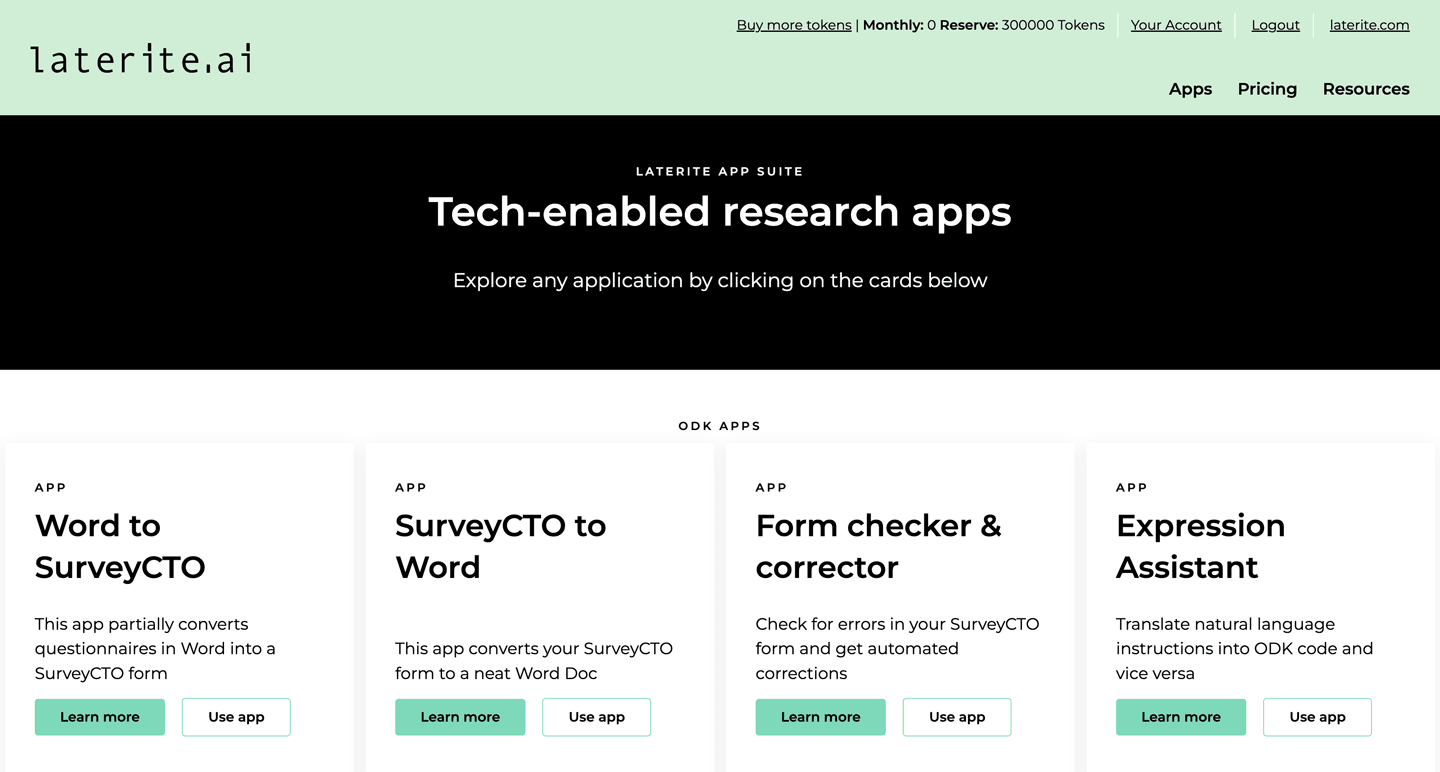
The Laterite app suite brings a set of tech-enabled research tools together on one page, each presented as a card users can explore. The ODK apps cover converting questionnaires between Word and SurveyCTO, checking and correcting forms, and translating plain-language instructions into ODK code - with "Learn more" and "Use app" options on every card. A token balance and account controls sit in the header.
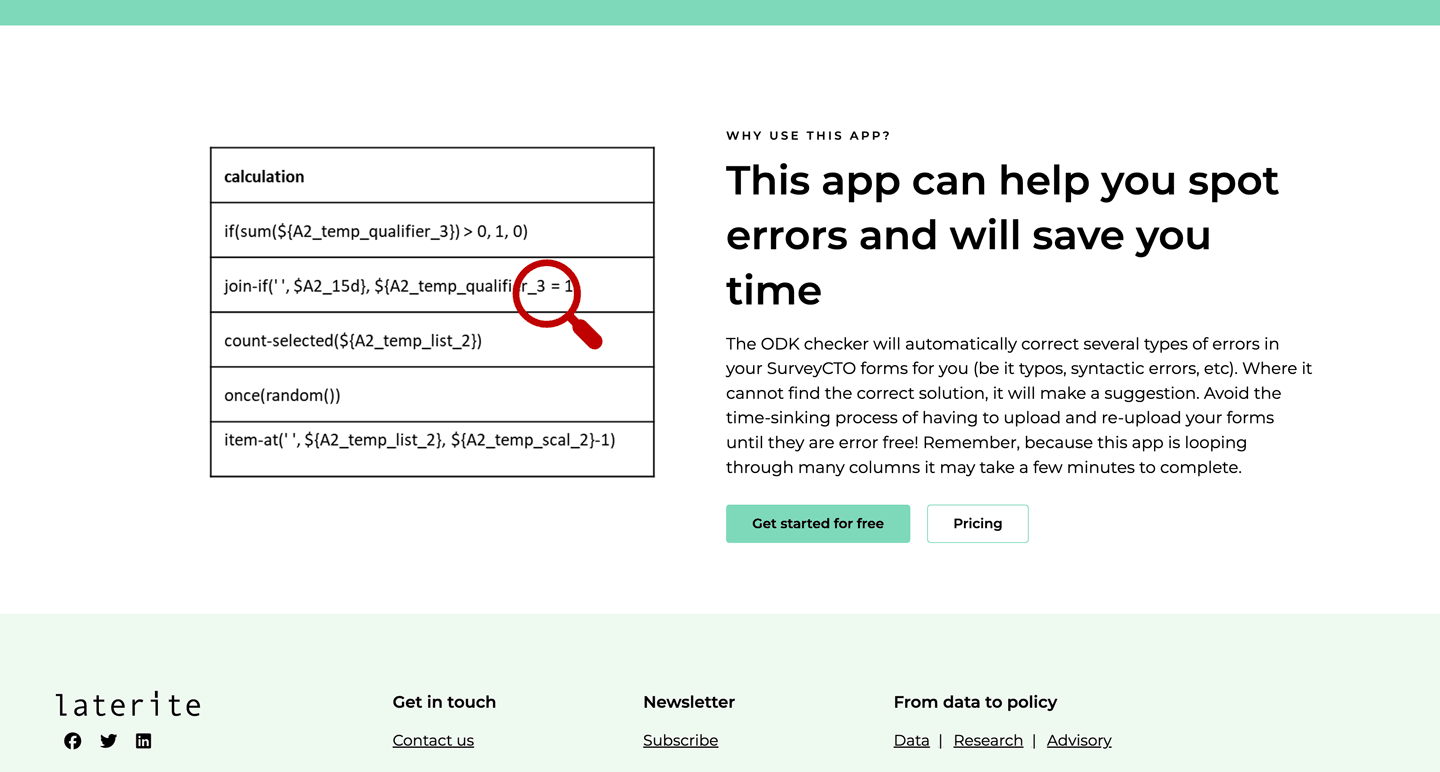
This "Why use this app?" section explains the Form Checker's value to users: it automatically scans SurveyCTO forms and corrects common errors like typos and syntax mistakes, suggesting fixes where it can't resolve them outright. An illustrated calculation table shows the kind of form logic it inspects, with clear "Get started for free" and "Pricing" routes into the product.
03 Conclusion
The simple design met the project's needs, but it was conceived just before AI - and ChatGPT in particular - surged in popularity. The next phase will introduce changes that show users exactly where their request is in the process and how long it might take, bringing the experience closer to other AI platforms people now know.
Throughout the build, we logged meticulously at every stage of the data journey. Because the platform relies on third-party services that return varying responses, being able to pinpoint an issue at the exact time and place it occurred proved essential.
The platform was delivered with everything needed for the alpha release. We expect the next phases to add more apps - from Laterite and other researchers - covering media types beyond text, documents, and spreadsheets, building towards a reliable suite of tools that help researchers do their jobs and, in turn, improve lives in communities across Africa and around the world.
04 Testimonial
"Laterite and AndAnotherDay partnered to develop and pilot a generative AI platform for researchers in the social sectors. The AndAnotherDay team distinguished themselves with a very genuine commitment to impactful work, marked by a friendly and very collaborative approach, and their expertise in structuring complex web-based applications. This collaboration resulted in a robust, scalable platform featuring a user-friendly interface, efficient customer and payment management systems, and a flexible back-end that facilitates the seamless integration of new AI applications. AndAnotherDay are an ideal partner for organizations looking to deploy tech-applications with a social purpose. "
Dimitri Stoelinga,
Co-Founder and Partner